Towing > Tow Bars & Base Plates > Blue Ox Tow Bars & Baseplates

The Class III 6,500lb towing capacity Alpha tow bar is constructed primarily of aluminum. Weighing in at only 37 pounds, with a 3-axis swivel design quickly connects and disconnects in minutes flat with the Signature Series easy-release locking handles! Its exclusive offset triple lug connection minimizes towing forces on the tow car. Safety cables come standard.
FEATURES

The Class IV Avail has a ball-in-socket design that reduces wear points between the coach and the tow car. Hook up and disconnect is a cinch with the 360-degree swivel and easily connects and disconnects with Signature Series easy-release locking handles when you’re out of alignment or on uneven surfaces. Our exclusive offset triple lug connection, minimizes the towing forces on the tow car. 10,000lb safety cables are included.
FEATURES
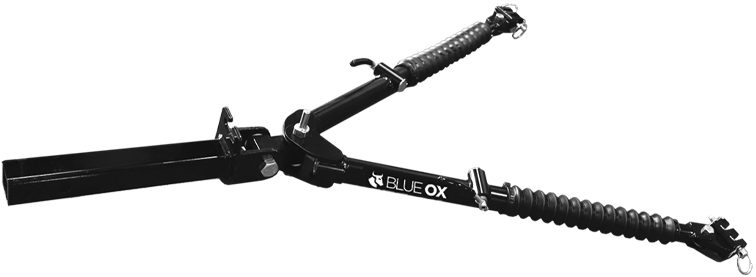
The Alpha 2 BX7380 is a Class III tow bar constructed of steel, and is rated for towing up to 6,500 pounds and with baseplates that have a maximum tab width of 32”. The Alpha is self-aligning with a 3-axis swivel design. Hook-up becomes simplified using the auto-locking arms.
FEATURES

FEATURES

FEATURES
Towing a vehicle behind your motorhome can be a pleasant experience and allow you the flexibility to enjoy your lifestyle to its fullest. When it comes to seeing the sights, running to town for supplies or taking day trips, your towed vehicle will allow you a convenient option.
Towing Options
There are three ways to bring your towed car with you, and you need to decide which option best suits your needs.
Tow Bars
The final & most popular choice is to tow all 4 wheels down using a tow bar. The main reason for choosing a tow bar is convenience. Tow bars give you the least amount of equipment to deal with to tow your vehicle. The biggest disadvantage with dollies and trailers is what to do with them when you get to the campground. Many campgrounds do not have room to let you park a trailer or dolly on your site along with your motorhome and towed vehicle. In most cases you would have to unhook the trailer and park it somewhere away from your campsite. With a tow bar you can unhook and the towing equipment will fold up and stay with your motorhome or your car and not take up any additional parking space. A tow bar is also lighter to carry than a dolly or trailer and prices for a tow bar start out lower than either a dolly or a trailer.
Self Aligning
Self-aligning tow bars provide you with the opportunity to hook up by yourself. The self-aligning feature allows you to drive up close to the motorhome and then let the tow bar adjust to the vehicles position. Then the tow bar will extend out to its rigid tow position as you pull ahead with the motorhome. Many users have called these tow bars temper savers and marriage savers. The choice between car mounted or motorhome mounted is a choice you will need to make.
Motorhome Mounted
Motorhome mounted tow bars are the latest & most popular innovation in tow bars. The main advantage of a motorhome mounted tow bar is the replacement of the ball coupler with a swivel joint. This allows the tow bar to be used without a drop ball mount, which in many cases hangs low enough to drag when a motorhome drives through a dip or starts up a ramp. The storage of the tow bar on the motorhome leaves the front of your car look much nicer when you are not towing. The motorhome is less likely to be left in a place where theft is a major problem and the tow bar can be locked into the receiver hitch of the motorhome to deter theft. This type of tow bar is also lighter and easier to handle than its car mounted counterpart.
Baseplates
When researching a towing system, do not overlook the baseplate. The baseplate bolts to the frame and is custom designed for each specific towed vehicle. Different baseplates will show significantly more than others will and a few require cutting of the bumper for installation. Some of the newer models have removable attachment tabs, which allows you to remove all exposed parts from the front of the vehicle. Baseplates come with all the necessary hardware to install them and will bolt to a secure place on the towed vehicle. On occasion you will need to drill holes in the frame to attach the baseplate, but no special tools are needed.
Accessories Available
Blue Ox provides all of the accessories that you may need or want for towing. For safety purposes, federal law requires RV activated taillights and safety cables. Also, most states and Canadian provinces have laws on the books concerning braking for trailers. Brakes are required on trailers with GVWR’s as low as 1,000 pounds in some states. Enforcement of these laws has not been followed most places in the United States. Interpretation of the law’s application to cars in tow has probably been a big reason why these laws have not been actively enforced. British Columbia province in Canada has been actively enforcing this law, stopping people, writing tickets and making them drive the tow car separately if they do not have the proper equipment. The main thing to remember with auxiliary braking systems is that they are just what they state – auxiliary brakes. They are not meant to stop your motorhome any faster. They are designed to assist in slowing down the towed vehicle and reduce the stopping distance that was changed due to the addition of the towed car.
Towability Issues
Most front wheel drive manual transmission cars can be towed with all four wheels on the ground with no modification. Most front wheel drive automatic transmission vehicles will need a lube pump or similar device in order to tow it four wheels down. Rear wheel drive automatics will require a device to disconnect the driveshaft in order to tow four down. There are some front wheel drive automatic transmission vehicles that can be towed without modification. Here are some examples: All Honda and Acura vehicles; All Saturn vehicles; 1995 and newer Chevrolet Cavalier and Pontiac Sunfire with 4T40E transmission; 1997 and newer Chevrolet Malibu and Old Cutlass with 4T40E transmission; 1999 and newer Pontiac Grand Am with 4T40E transmission. Also, some 4 wheel drive vehicles can be towed (both automatic and manual transmission). Refer to your vehicle’s owners manual for specific instructions and limitations.
Towing Safety Checklist
During Hook Up:
Each time you stop, check the tow bar, base plate and cables to make sure they are still properly attached. Check the tires of the towed vehicle to make sure they are not going flat. If you are using a dolly or trailer, check the wheels to make sure they are not hot to the touch. If the wheels are hot, it may indicate a brake or bearing problem.
Each day before you start check the lights to make sure they are working properly.
Between trips clean the towbar and cables to keep them in good shape. Also, clean and lubricate the tow bar as recommended by the manufacturer’s instructions.


